
The Complete Guide to Obsessive-Compulsive Disorder (OCD): Symptoms, Intrusive Thoughts, and Treatment
Learn what obsessive-compulsive disorder (OCD) is, why intrusive thoughts occur, how the OCD cycle works, and how treatments like ERP and ACT help people break free from compulsions.
OCD Guide
The human brain produces hundreds of thousands of thoughts each day. Most of the time, we barely notice them. Thoughts appear, pass through our minds, and disappear without much effort or attention.
For the most part, our brains are very good at letting these thoughts come and go. A strange idea might pop up, a worry might cross our mind, or a random image might appear briefly, and then our attention moves on to whatever we’re doing.
But for people living with obsessive-compulsive disorder (OCD), certain thoughts don’t pass through so easily. Instead, some thoughts can become sticky. They grab our attention and refuse to let go. The brain treats them as important, dangerous, or urgent, which can trigger intense anxiety or doubt.
When this happens, it’s natural to want relief from the discomfort. People may find themselves trying to figure out the thought, make sure nothing bad will happen, seek reassurance, or perform certain actions to reduce the anxiety. While these strategies can bring temporary relief, they often end up strengthening the cycle that keeps OCD going.
The good news is that OCD is well understood, and there are effective treatments that help people step out of this cycle and relate to their thoughts in a very different way.
In this guide, we’ll explore what OCD is, how it works, how it shows up in everyday life, and what evidence-based treatment can look like.
What Is OCD?
Obsessive-compulsive disorder (OCD) is a mental health condition that involves two main components: obsessions and compulsions.
Obsessions
Obsessions are intrusive thoughts, images, urges, or even physical sensations that show up in the mind and trigger anxiety, fear, distress, or other strong emotions. These experiences are often unwanted and feel inconsistent with how someone actually sees themselves.
People with OCD are usually very aware that these thoughts are strange, exaggerated, or unlikely, but that awareness doesn’t make them easier to dismiss.
In fact, many people with OCD say the thoughts feel especially upsetting because they go so strongly against their values or intentions.
Obsessions can take many forms. Some common examples include thoughts such as:
What if I accidentally hurt someone?
What if I left the stove on and something bad happens?
What if my partner isn’t actually the “right” one for me?
What if this cup is contaminated and I contract a disease that could harm my family or me?
These thoughts can feel incredibly urgent or important, even when a person logically knows they probably aren’t.
Compulsions
Compulsions are things someone feels driven to do to relieve the anxiety created by the obsession. The goal of the compulsion is usually to reduce distress, gain certainty, or prevent something bad from happening.
Some compulsions are visible behaviors, such as:
checking locks, appliances, or doors
washing or cleaning repeatedly
asking others for reassurance
avoiding certain people, places or situations
Other compulsions happen internally and may be less obvious to others. These can include:
mentally reviewing past events
trying to “cancel out” a thought with another thought
repeatedly analyzing whether something is true or not
trying to “figure it out” by endlessly ruminating
trying to force a thought to go away
Compulsions often bring temporary relief, but that relief usually doesn’t last long. Over time, the brain begins to rely on the compulsion as a way to manage anxiety, which is one of the reasons OCD can become such a persistent cycle.
In the next section, we’ll take a closer look at how that cycle works and why the strategies people naturally use to feel better can unintentionally keep OCD going.
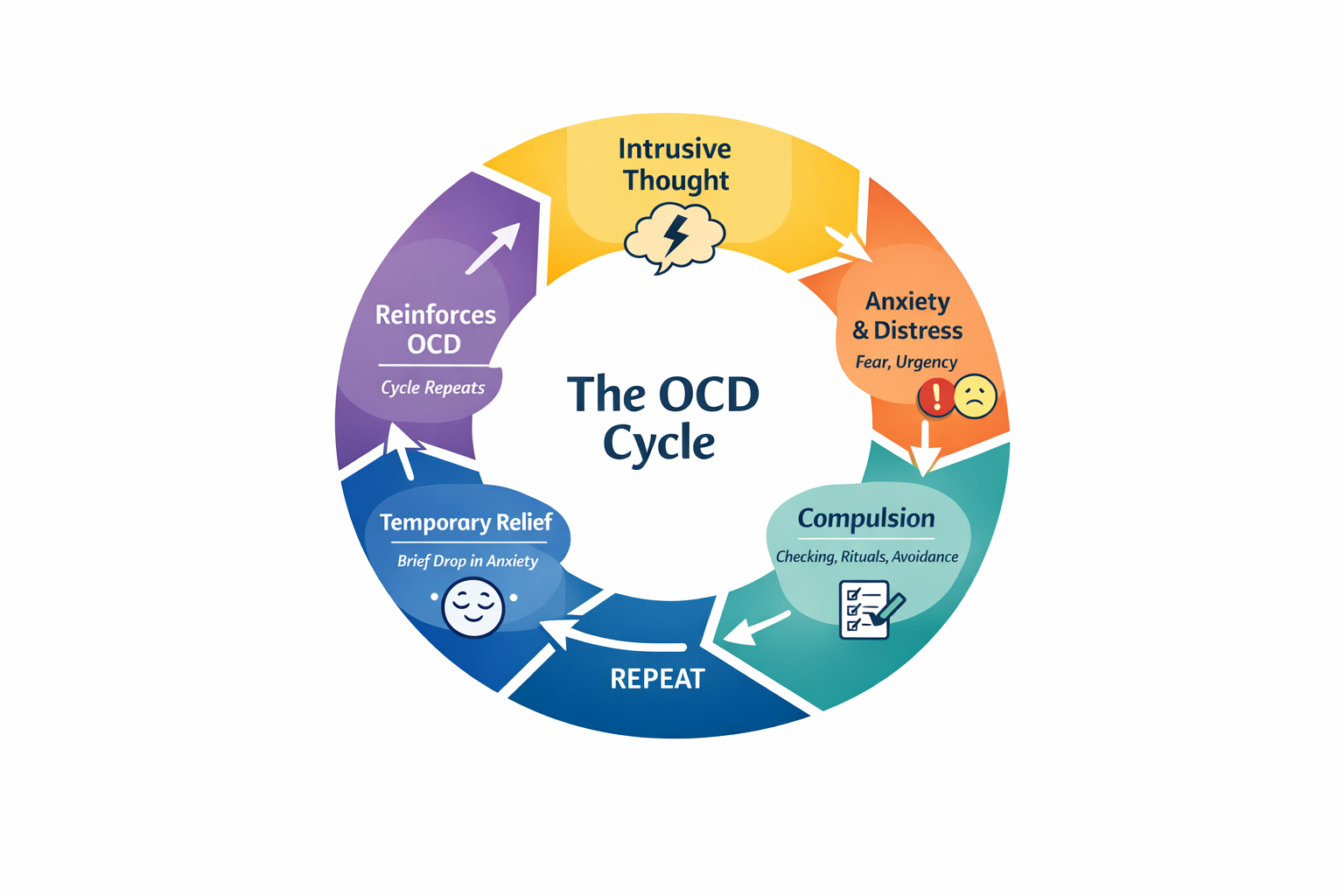
The OCD Cycle
To understand why OCD can feel so persistent, it helps to look at what clinicians often call the OCD cycle.
OCD tends to follow a repeating pattern. An intrusive thought appears, distress increases, and a person naturally tries to do something to make the anxiety go away. The problem is that the strategies people use to reduce the discomfort often end up strengthening the cycle over time.
Many people say that seeing this cycle clearly explained is the moment when OCD finally starts to make sense.
Let’s look more closely at each part of the cycle.
Intrusive Thoughts
The cycle usually begins with an intrusive thought, image, urge, sensation, or doubt that suddenly grabs the brain’s attention.
Intrusive thoughts are actually very common. Most people experience strange or uncomfortable thoughts from time to time. The difference with OCD is that the brain treats certain thoughts as extremely important or threatening, even when they may not actually be dangerous.
When OCD is involved, the thought becomes sticky, pulling attention toward it and demanding that it be taken seriously.
Emotional Distress
Once the intrusive thought appears, it often triggers strong emotional reactions.
These emotions might include:
anxiety
fear
guilt
disgust
uncertainty
a strong sense of responsibility
The brain interprets the thought as a potential threat, activating the body’s alarm system. This can create an intense feeling that something needs to be addressed right away.
For many people with OCD, this distress feels incredibly real and convincing, even when another part of them logically recognizes that the thought may not make sense.
Compulsions
Compulsions are things someone feels driven to do in order to reduce the distress created by the obsession.
The goal of the compulsion is usually to gain certainty, reduce anxiety, or prevent something bad from happening.
Some compulsions are visible behaviors, such as:
checking locks, appliances, or doors
washing or cleaning repeatedly
asking others for reassurance
avoiding certain situations
Other compulsions happen internally and may be harder for others to see. These can include:
mentally reviewing past events
analyzing a thought repeatedly
trying to “cancel out” a thought with another thought
trying to force the thought to disappear
Temporary Relief
After performing a compulsion, anxiety usually drops — at least for a short time.
This relief can feel like confirmation that the action was helpful. The brain essentially learns that performing the behavior reduced the discomfort.
Because the relief feels so powerful, it makes sense that someone would rely on the compulsion again the next time the thought appears.
Reinforcing the Cycle
Unfortunately, the temporary relief teaches the brain an unintended lesson: the thought must have been important or dangerous.
As a result, the brain becomes more likely to sound the alarm again in the future. Intrusive thoughts may appear more frequently, anxiety may spike more quickly, and the urge to perform compulsions becomes stronger.
Over time, the cycle reinforces itself.
The encouraging news is that effective OCD treatments focus on interrupting this pattern, helping people respond to intrusive thoughts in a completely different way.
Common Signs and Symptoms of Obsessive-Compulsive Disorder
Obsessive-compulsive disorder can show up in many different ways, but most experiences of OCD share a few common patterns. Many people feel stuck obsessing over a scary thought, or experience thoughts that intrude into their mind like unwanted guests. These thoughts create emotional distress, and people naturally try to reduce that discomfort through what clinicians call compulsions.
Because compulsions can be both visible behaviors and internal mental processes, OCD isn’t always obvious from the outside. In fact, many people live with OCD for years before realizing that the thoughts and behaviors they’re experiencing have a name.
Some common signs and symptoms of OCD include:
Persistent Intrusive Thoughts
Many people with OCD experience thoughts that feel unwanted, disturbing, or difficult to ignore. These thoughts often repeat and can feel urgent or important, even when the person logically knows they may not make sense.
Common themes might include fears about harming someone, contamination, making mistakes, or doubts about important relationships. Some people also worry about losing control, going crazy, or losing their mind, or fear that their thoughts mean they are somehow a bad or immoral person.
Intense Emotional Distress
When intrusive thoughts appear, they often trigger strong emotional reactions. While anxiety is the most common, there is an important difference between OCD and anxiety. OCD can also bring up a range of other emotions such as:
anxiety
fear
guilt
disgust
uncertainty
a strong sense of responsibility for preventing harm
The brain interprets the thought as a possible threat, which activates the body’s alarm system. This can create an intense feeling that something needs to be addressed immediately.
Compulsive Behaviors
Some compulsions are outward behaviors that others might notice. These actions are usually performed in an attempt to reduce anxiety or gain certainty.
Examples can include:
repeatedly checking locks, appliances, or doors
excessive washing or cleaning
arranging items until they feel “just right.”
asking others for reassurance
Mental Compulsions
Not all compulsions are visible. Many people with OCD experience mental rituals, which can make the condition harder to recognize.
Mental compulsions might include:
replaying events in your mind to make sure nothing bad happened
trying to neutralize a thought with another thought
analyzing thoughts repeatedly to figure out what they mean
trying to force a thought to go away
These mental behaviors are still compulsions, even though they happen internally.
Avoidance
People with OCD often begin avoiding situations, places, or objects that might trigger intrusive thoughts or anxiety.
For example, someone with contamination fears might avoid touching certain surfaces, while someone with harm-related obsessions might avoid being around certain objects or even other people for fear of harming them.
Avoidance can temporarily reduce distress, but over time, it can make the cycle of OCD stronger.
Reassurance Seeking
Another common pattern in OCD is repeatedly asking others for reassurance.
Someone might ask questions like:
“Are you sure everything is okay?”
“Do you think I did something wrong?”
“Do you think this thought means something about me?”
“Is this normal?”
While reassurance can bring short-term comfort, it often reinforces the OCD cycle over time, increasing the urge to seek it again and again.
Feeling Stuck in Doubt
Many people with OCD describe feeling trapped in persistent doubt.
Even when something seems logically resolved, the mind continues to ask “What if?” questions. This constant uncertainty can make it difficult to move on from thoughts or decisions.
If you're wondering whether these patterns might apply to you, you can also explore our article on the signs and symptoms of OCD
When Symptoms Begin to Interfere With Daily Life
OCD symptoms can range from mild to severe, but they often begin to interfere with daily life when intrusive thoughts and compulsions take up significant time, energy, or emotional space.
Clinically, OCD is typically diagnosed when obsessions or compulsions are time-consuming or significantly interfere with work, relationships, or daily functioning, and when the symptoms are not better explained by another mental health condition, medical issue, or substance use.
The encouraging news is that these patterns are very treatable, and understanding how OCD works is often the first step toward breaking the cycle.
Common Types and Themes of OCD
Although OCD follows the same underlying cycle, the specific fears or themes can vary widely from person to person. These themes are sometimes referred to as “types” or “subtypes” of OCD, but they are not separate diagnoses. Instead, they describe the different ways intrusive thoughts and compulsions can show up.
Many people with OCD experience more than one theme over time, and it’s also common for the focus of OCD to shift. What stays consistent is the pattern of intrusive thoughts triggering distress, followed by attempts to reduce that distress through mental or physical compulsions.
Below are some common ways OCD can appear.
Contamination OCD
Contamination-related OCD involves fears about germs, illness, toxins, or environmental contaminants.
Someone with this theme might worry about becoming sick or accidentally spreading germs to others. Intrusive thoughts might focus on everyday situations, such as touching objects in public spaces or handling food.
Common compulsions can include:
excessive handwashing or cleaning
avoiding certain objects or environments
repeatedly washing items like clothing or dishes
seeking reassurance about contamination
watching others for signs of sickness
Losing Control OCD
This theme involves fears about losing control of one’s actions, thoughts, or behavior.
People may worry that they could suddenly act on a disturbing thought, say something inappropriate, or behave in a way that harms others or themselves.
Intrusive thoughts might include fears such as:
What if I suddenly snap and hurt someone?
What if I lose control of myself in public?
What if I do something completely out of character?
What if I go crazy?
Compulsions may include mentally analyzing the thought, avoiding certain people, places, or situations, or seeking reassurance that they would never actually act on it.
Harm OCD
Harm-related OCD involves intrusive thoughts about accidentally or intentionally harming oneself or someone else.
These thoughts can be deeply upsetting because they go strongly against the person’s values. Someone experiencing harm OCD may worry that the presence of the thought means something about their character or intentions.
Importantly, these intrusive thoughts occur without any actual desire or intent to harm anyone. In fact, people with this form of OCD are often extremely distressed precisely because harming others—or themselves—is the opposite of what they want.
Compulsions may include:
avoiding objects that could potentially cause harm
avoiding being around other people
mentally reviewing past situations to make sure no harm occurred
seeking reassurance that they are not dangerous
Perfectionism OCD
Perfectionism-related OCD involves intense pressure to do things perfectly or without mistakes.
Someone with this theme may feel responsible for preventing errors or ensuring that everything is done “just right.” Even small imperfections can trigger anxiety or a sense that something isn’t complete.
Compulsions may include:
repeatedly checking work or tasks
arranging items until they feel correct
rewriting or redoing tasks multiple times
mentally reviewing actions to ensure nothing was missed
Sexual Orientation OCD
Sexual orientation OCD involves intrusive doubts or fears about one’s sexual orientation.
These thoughts can be confusing and distressing, especially because they often feel inconsistent with a person’s identity or lived experience.
Intrusive questions might include:
What if I’m actually attracted to someone I shouldn’t be?
What if I’ve misunderstood my orientation?
What if these thoughts mean something about who I really am?
Compulsions can include analyzing feelings, comparing reactions to others, or seeking reassurance about identity.
Morality or Scrupulosity OCD
Morality-related OCD (often called scrupulosity) involves fears about doing something wrong, immoral, or unethical.
Someone with this theme may worry excessively about whether they behaved correctly or whether they might have unintentionally violated a moral or religious rule.
Compulsions may include:
repeatedly seeking reassurance about moral decisions
excessive apologizing or confessing
mentally reviewing actions to determine whether they were ethical
excessive prayer
Relationship OCD (ROCD)
Relationship OCD involves persistent doubt about romantic relationships.
Intrusive thoughts might include questions such as:
What if my partner isn’t the right one for me?
What if I don’t actually love them enough?
What if I’m making the wrong choice?
People with ROCD may find themselves analyzing their feelings, comparing their relationship to others, or repeatedly seeking reassurance about the relationship.
Health OCD
Health-related OCD involves intrusive fears about illness, disease, or bodily sensations.
Someone with this theme might worry that normal physical sensations signal a serious illness, or that certain changes in the body mean something is dangerously wrong.
Compulsions may include:
repeatedly checking the body for symptoms
excessive health-related research or reassurance seeking
avoiding situations that may increase heart rate or physical sensations, such as exercise or caffeine
A Shared Pattern
Even though these themes may look very different on the surface, they are all driven by the same underlying process: intrusive thoughts triggering distress, followed by compulsions that temporarily reduce anxiety but ultimately reinforce the OCD cycle.
Understanding this shared pattern is important because effective treatment focuses on changing the relationship to these thoughts, rather than trying to eliminate them entirely.
Intrusive Thoughts Explained
Intrusive thoughts are one of the most confusing and distressing parts of OCD. Many people feel frightened not only by the thought itself, but by what they believe the thought might mean about them. Many people also wonder whether what they’re experiencing is OCD or another form of anxiety, which we explore in more detail in this article about the difference between OCD and anxiety.
One of the most important things to understand is that intrusive thoughts are actually a normal part of being human. Research has consistently shown that nearly everyone experiences strange, unwanted, or disturbing thoughts from time to time.
A person might suddenly think something violent, inappropriate, or completely out of character (ie: “what if I stick my hand in that blender”). For most people, these thoughts pass through the mind quickly and are dismissed without much attention.
With OCD, however, the brain treats certain thoughts very differently.
Instead of letting the thought drift by, the mind begins to focus on it intensely. The brain sends the message that the thought must be important, dangerous, or meaningful in some way. As a result, the person may start analyzing the thought, trying to figure out what it means, or attempting to make absolutely sure it never becomes reality.
Ironically, the more someone tries to control or eliminate a thought, the more attention the brain gives to it.
You can think of intrusive thoughts a bit like trying not to think about something specific. The moment someone says, “Don’t think about a pink elephant,” the mind immediately produces the image of one.
The same process can happen with intrusive thoughts. The harder the brain works to push the thought away, the more noticeable and persistent it can become.
This is one of the reasons OCD can feel so exhausting. People are often trying very hard to manage their thoughts, but the strategies they use can unintentionally keep the thoughts active.
Understanding that intrusive thoughts are a normal mental event rather than a meaningful signal can be an important step in learning to relate to them differently.
Why OCD Persists
One of the most frustrating parts of OCD is that the things people naturally do to cope with their thoughts often end up keeping the cycle going.
When an intrusive thought triggers anxiety or distress, it makes sense to want relief. Most people instinctively try to solve the thought, gain certainty, ask for reassurance, or prevent something bad from happening. In the short term, these strategies can feel helpful.
But over time, they tend to reinforce the OCD cycle.
This happens because each time a compulsion reduces anxiety, the brain learns an important, but misleading, lesson: the thought must have been dangerous.
In other words, the relief that follows the compulsion teaches the brain that performing the behavior was necessary. As a result, the brain becomes more likely to send the same alarm again the next time a similar thought appears.
Over time, this pattern can make intrusive thoughts feel more frequent, more urgent, and harder to ignore.
Another reason OCD persists is that people often begin trying to control or eliminate their thoughts entirely. This can include analyzing the thought repeatedly, trying to push it away, or searching for certainty that it will never happen.
Unfortunately, the mind doesn’t work well that way.
The more attention someone gives to a thought, whether by analyzing it, fighting it, or trying to make it disappear, the more significant the brain begins to treat it.
You can think of it a bit like trying to put out a fire with gasoline. The goal is to get rid of the fire, but the strategy being used actually fuels it. The same thing can happen with OCD. The behaviors people use to feel better in the moment can unintentionally make the cycle stronger over time.
Many of the strategies people use to cope with OCD are completely understandable. Seeking reassurance, avoiding certain situations, checking things repeatedly, or trying to mentally “solve” a thought are all attempts to feel safer or more certain.
The challenge is that these behaviors often strengthen the brain’s belief that the alarm was justified.
The encouraging news is that effective treatment for OCD focuses on interrupting this pattern. Instead of trying to eliminate intrusive thoughts, therapy helps people learn a different way of responding to them, one that gradually weakens the cycle rather than reinforcing it.
If you'd like a deeper understanding of how intrusive thoughts, distress, compulsions, and temporary relief work together to keep OCD going, read The OCD Cycle: Why Intrusive Thoughts and Compulsions Keep Repeating.
How OCD Is Treated
The good news is that OCD is highly treatable, and over the past several decades, researchers have developed therapies that are very effective at helping people step out of the OCD cycle.
One of the most well-established treatments for OCD is called Exposure and Response Prevention (ERP).
ERP is a form of cognitive behavioral therapy that focuses on helping people gradually face the thoughts, situations, or sensations that trigger anxiety, while learning not to perform the compulsions that usually follow.
At first, this can sound intimidating, but the goal is not to overwhelm someone with fear. Instead, exposures are introduced gradually and thoughtfully, allowing people to build confidence in their ability to tolerate uncertainty and discomfort.
Over time, something important begins to happen.
When someone experiences an intrusive thought or trigger and chooses not to perform the compulsion, the brain starts to learn a new lesson: they do not need certainty in order to move forward. Instead of trying to prove whether the feared outcome will or will not happen, treatment helps people practice tolerating the uncertainty and discomfort that OCD brings up.
With repeated practice, people begin to build confidence in their ability to handle anxiety, doubt, and unwanted thoughts without relying on compulsions. Over time, the brain’s alarm system becomes less reactive, and the intrusive thoughts often lose some of their intensity and power.
Another approach that can be very helpful in OCD treatment is Acceptance and Commitment Therapy (ACT).
ACT focuses on helping people change their relationship with thoughts and emotions. Instead of trying to control or eliminate intrusive thoughts, people learn skills that help them step back from their thoughts, observe them with less judgment, and refocus their attention on what truly matters in their lives.
In many cases, ERP and ACT work very well together. ERP helps people break the behavioral cycle of compulsions, while ACT helps people build mindfulness skills and develop a more flexible and compassionate relationship with their thoughts and emotions.
Together, these approaches help people learn that intrusive thoughts do not have to control their actions or define who they are.
Recovery from OCD doesn’t mean never having intrusive thoughts again. Instead, it means learning how to respond to those thoughts in a way that no longer fuels the cycle.
When to Seek Help for OCD
Many people experience occasional intrusive thoughts or moments of doubt. That alone doesn’t mean someone has OCD.
However, it may be helpful to seek support if intrusive thoughts and compulsive behaviors begin to take up significant time, cause distress, or interfere with daily life.
Some signs that it might be helpful to speak with a mental health professional include:
spending large amounts of time each day managing intrusive thoughts
feeling stuck in cycles of checking, reassurance seeking, or mental reviewing
avoiding situations, places, or responsibilities because they trigger anxiety
feeling overwhelmed by uncertainty or fear about what thoughts might mean
noticing that OCD is affecting relationships, work, school, or daily functioning
Many people live with OCD for years before realizing that what they’re experiencing has a name. Learning about OCD can be an important first step, but working with a therapist who understands the condition can help people begin practicing the skills needed to step out of the cycle.
Hope and Recovery
OCD can feel incredibly convincing and exhausting. When intrusive thoughts appear repeatedly, and anxiety feels urgent, it can seem as though the mind will never quiet down.
But OCD is very treatable.
With approaches like Exposure and Response Prevention (ERP) and Acceptance and Commitment Therapy (ACT), many people learn a completely different way of responding to their thoughts and emotions.
Recovery doesn’t mean that intrusive thoughts disappear forever. Instead, it means learning how to notice thoughts without getting pulled into the cycle that OCD tries to create.
Over time, people often find that their thoughts become less powerful, anxiety becomes easier to tolerate, and life begins to feel larger than OCD again.
For many people, the most meaningful part of recovery is rediscovering the ability to move toward the things that matter: relationships, work, creativity, and experiences that give life meaning, without OCD dictating every step.
Frequently Asked Questions
-
Yes. Research shows that most people experience strange, unwanted, or disturbing thoughts at times. These thoughts are simply a normal product of the brain generating ideas and possibilities.
What makes OCD different is not the presence of the thought, but how the brain responds to it. With OCD, certain thoughts trigger intense distress and lead to repeated attempts to neutralize or control the thought through compulsions.
-
No. Intrusive thoughts in OCD are typically ego-dystonic, meaning they go strongly against a person’s values, intentions, or sense of identity.
In fact, people with OCD are often distressed precisely because the thoughts feel so inconsistent with who they are. The presence of a thought does not mean someone intends to act on it or wants it to occur.
-
OCD is generally considered a chronic condition, but it is highly treatable. Many people learn effective ways to manage their symptoms and significantly reduce the impact OCD has on their lives.
With evidence-based treatments such as Exposure and Response Prevention (ERP) and approaches like Acceptance and Commitment Therapy (ACT), people can develop skills that help them respond to intrusive thoughts differently and break the cycle of compulsions.
-
The most well-supported treatment for OCD is Exposure and Response Prevention (ERP). ERP helps people gradually face situations, thoughts, or sensations that trigger anxiety while learning not to perform compulsions.
Over time, this process helps the brain become less reactive to intrusive thoughts and builds confidence in a person’s ability to tolerate uncertainty and discomfort.
-
It may be helpful to seek professional support if intrusive thoughts and compulsive behaviors begin to take up significant time, cause distress, or interfere with daily life.
If someone finds themselves repeatedly checking things, seeking reassurance, avoiding situations, or feeling overwhelmed by doubt and anxiety, working with a therapist experienced in OCD treatment can be an important step toward recovery.
-
OCD is related to anxiety but is considered a separate disorder. While anxiety plays a large role in OCD, the condition is defined by the presence of obsessions and compulsions that create a repeating cycle.
Understanding this cycle is important because the treatments used for OCD, particularly ERP, are different from many traditional anxiety treatments.