
Do I Have OCD?
Many people find themselves quietly wondering, “Do I have OCD?” often after getting stuck in a thought spiral that won’t let go. You might replay conversations, question your intentions, worry about what a thought says about you, or feel caught in mental loops that don’t resolve no matter how much you analyze them. You may have told yourself you’re just overthinking. And yet, the pattern keeps repeating.
Obsessive-Compulsive Disorder (OCD) is widely misunderstood. It’s often associated with visible behaviors like excessive cleaning, handwashing, or organizing, but many OCD symptoms in adults are far more internal. OCD can show up as intrusive thoughts that feel distressing or out of character, followed by mental or behavioral rituals meant to reduce anxiety or regain certainty. The relief is usually brief, and then the doubt returns.
There are many different “flavors” of OCD. Some people experience fears around harm or safety. Others get stuck in relationship doubts, moral or religious worries, health fears, or intrusive thoughts that feel shocking or shameful. The theme may change, but the cycle underneath it tends to look the same.
If you’ve been questioning whether what you’re experiencing could be OCD, you’re not alone. Below, we’ll walk through the common signs of OCD in adults, how intrusive thoughts and compulsions operate, and when it may make sense to seek support.
What Is OCD (Obsessive-Compulsive Disorder)?
Obsessive-Compulsive Disorder is a mental health condition characterized by obsessions (intrusive thoughts, images, or urges) and compulsions (repetitive behaviors or mental acts done to reduce distress). OCD symptoms in adults often revolve around doubt, uncertainty, and attempts to feel completely sure.
An obsession is not just a typical worry. It’s usually intrusive, unwanted, and persistent. It may feel upsetting, confusing, or even out of character. Common OCD themes include fears of harming someone, relationship doubts, health anxiety, religious or moral concerns, fears of losing control or “going crazy,“ gender orientation, or intrusive thoughts that feel taboo or frightening. The specific theme may vary —the “flavor” might shift—but the underlying experience often feels similar: sticky, urgent, and what might feel impossible to dismiss.
A compulsion is what someone does to try to feel better or more certain. Some compulsions are visible, like checking, washing, or asking for reassurance. Others are completely internal: mentally reviewing a conversation, analyzing what a thought means, scanning your body for sensations, silently repeating phrases, Googling for certainty, or trying to cancel out a thought with a “better” one. These mental compulsions can make OCD especially difficult to recognize.
The defining feature of OCD is not just intrusive thoughts; it’s the cycle that forms around them.
The OCD Cycle: How Obsessions and Compulsions Reinforce Each Other
At the core of OCD is a predictable loop, often called the OCD cycle.
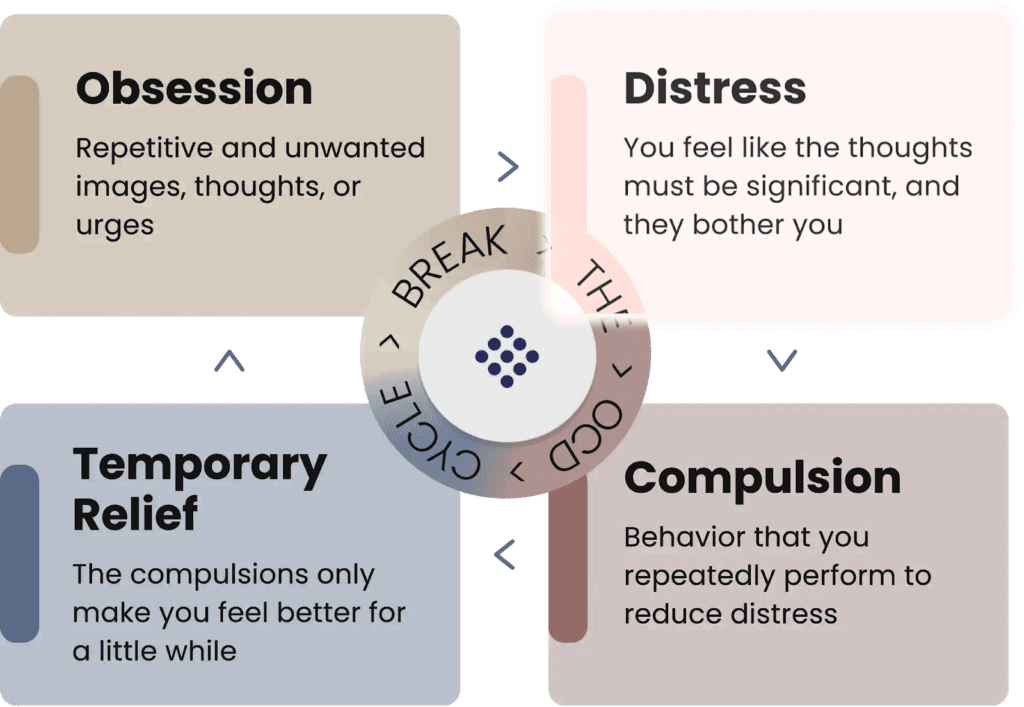
The cycle begins with an intrusive thought, image, or urge. It isn’t invited. It doesn’t ask permission. It often shoves its way in like an unexpected intruder: loud, disruptive, and hard to ignore. The thought might be something like, “What if I hurt someone?” “What if I don’t really love my partner?” “What if I missed something important?” or even “What if I go crazy or lose my mind?”
That thought sparks anxiety (or fear, shame, disgust, etc.), sometimes sharply, like an emotional fire. The discomfort can feel urgent and overwhelming. Naturally, your system wants relief.
This is where the compulsion comes in. A compulsion is an attempt to put the fire out— checking, reassurance-seeking, mental reviewing, Googling, avoiding, and repeating phrases internally. And for a moment, it works. The anxiety decreases. There’s a brief sense of control.
But in OCD, the compulsion isn’t water, it’s gasoline.
It may quiet the flames for a moment, but it teaches the brain that the fire was dangerous and needed to be extinguished immediately. That reinforcement strengthens the cycle. The next time the intrusive thought appears, the fire can burn faster and feel more intense.
Over time, this loop becomes exhausting. Many people assume the intensity of the anxiety means the thought is important or meaningful. In OCD, the distress isn’t evidence of danger; it’s evidence of getting caught in the cycle.
Understanding this pattern is often the first step toward changing it.
Common Signs of OCD in Adults
OCD doesn’t always look dramatic. Some common signs of OCD in adults include:
Repetitive intrusive thoughts that feel distressing or unwanted
Persistent doubt that doesn’t resolve with reassurance
Mental reviewing, analyzing, or replaying events
Repeated checking or reassurance-seeking
Avoidance of situations that trigger intrusive thoughts
Spending significant time trying to feel “certain” or “just right”
Many adults with OCD appear high-functioning externally while privately feeling stuck in mental loops. If you'd like a deeper explanation of how obsessive-compulsive disorder works, you can read our complete guide to OCD.
When It Might Be More Than “Just Overthinking”
Everyone experiences intrusive thoughts from time to time. The difference with OCD is how sticky the thoughts become and how much effort goes into neutralizing or trying “to get rid of” them.
You might consider seeking support if:
The thoughts feel repetitive and hard to disengage from
You spend significant time performing rituals or mental compulsions
The doubt feels urgent or intolerable
Avoidance is shaping your decisions
The cycle is interfering with work, relationships, or well-being
If you find yourself constantly negotiating with your thoughts, OCD may be worth exploring.
How OCD Is Treated: ERP and ACT
Good news: OCD is highly treatable. Bad news: it doesn’t typically “just go away” on its own; it usually intensifies.
The gold standard treatment for OCD is Exposure and Response Prevention (ERP). ERP works by gradually helping someone face the thoughts or situations that spark anxiety while choosing not to perform the compulsion that normally follows.
If compulsions are like pouring gasoline on an emotional fire, ERP is the practice of stepping back and not adding fuel.
Instead of rushing to put the fire out, you learn to let the anxiety rise without responding in the usual ritualized way. Over time, the nervous system learns that the fire burns on its own and eventually dies down.
Many clinicians also integrate Acceptance and Commitment Therapy (ACT). ACT focuses on changing your relationship with thoughts rather than eliminating them. Instead of asking, “Is this thought true?” ACT helps you ask, “How do I want to respond when this thought shows up?”
ERP builds tolerance. ACT builds flexibility. Together, they help you step out of the cycle rather than fight with it.
If You’re Wondering Whether You Have OCD
You don’t have to rush to diagnose yourself. In fact, consulting with a mental health professional with training in OCD treatment is a great first step for gaining more clarity.
Intrusive thoughts (yes, even the ones that feel frightening or shameful) are far more common than people realize. The distress they create often reflects your values, not your character.
If you’re located in Newport, Rhode Island, or elsewhere in RI and wondering whether what you’re experiencing might be OCD, a consultation can help clarify next steps. You don’t have to navigate the cycle alone. With the right support, it can shift.
